
SEO Insights
Google Ads Decoded: what longer search questions change for cross-border stores
“Small bedroom, running overnight. Which air purifier is quiet and has filters I can actually buy?”
If you sell air purifiers, you can probably picture that support message. The shopper wants to know whether the unit fits, how loud it gets, and what happens when the filter wears out. A page that says “powerful purification” leaves them to look all three up somewhere else.
That is what this episode of Ads Decoded brings into focus. Shoppers can put several conditions into one search and follow up on the answer. Google separately announced more AI Mode ad markets the same day. Before paying to bring more people in, open one product page on your phone and see how many of those answers you can find.
The purifier is an example. We checked Google’s public materials and feed template on 10 November 2026. Campaign spend and purchases still need to be measured in your own account.
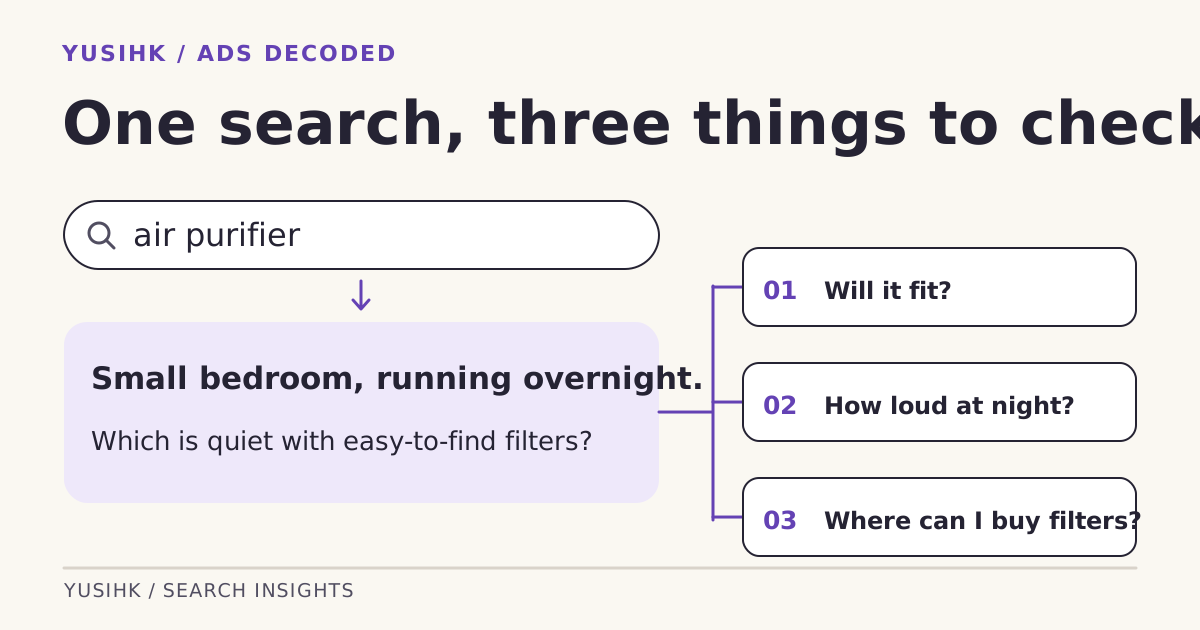
Does a longer question mean someone is ready to buy?
On 28 October, Google Ads Product Liaison Ginny Marvin spoke with Shivani Mohan, Google Search VP of Data Science and UXR, about research into how billions of people search. The episode description points to more ways of expressing context in AI search, including follow-ups, voice and images. The research scale refers to users observed. Individual queries are not part of a public dataset. Google announcement · Episode page
The U.S. AI Mode report, page 4, cited in Google's accompanying advertising announcement, says average AI Mode queries are three times as long as traditional queries. It also reports growth in both short and long queries. This does not establish that long questions dominate all Google searches, convert better, or describe Japanese and Hong Kong Chinese usage.
An average tells you how much people type. The question itself tells you what they still need to decide.
A long-form query describes how much someone put into a question. A long-tail term usually describes where that term sits in the distribution of search demand. “F12 replacement filter” is short, could be uncommon, and gives you a clear product need. “Should I open my bedroom window or use an air purifier if the room gets dusty?” is longer and still exploratory. Make the first search easy to fulfil on a product page. Answer the second in a guide and link to the relevant models.
AI Mode ads reach 10 more markets. Can your store take part?
Start with where your customers search, the language they use, and whether your existing campaign and products are eligible. We checked the announcement against Google's English, Traditional Chinese and Japanese help pages on 10 November 2026. Google's 28 October announcement · Google Ads Help
| Where you sell | What Google currently documents |
|---|---|
| Australia, Canada, India, Kenya, Malaysia, New Zealand, Nigeria, Pakistan, the Philippines and Singapore | Google announced it was scaling ads within AI Mode on 28 October. The help page lists English and limits Pakistan to text ads. |
| United States | AI Mode ads are already available. Google separately announced ads in follow-up questions on 28 October. It gave no corresponding follow-up launch for the ten new markets. |
| Brazil, Mexico and the UK | Planned for Q4 2026. At the time of the check, they were still absent from the help page's market list for ads within AI Mode, with no published start date. |
| Hong Kong, Japan and Indonesia | Hong Kong and Japan are absent from that ad-market list. Indonesia is listed for ads within AI Overviews only. Access to AI Mode itself and ads above or below AI Overviews follow separate availability rules. |
Eligible existing Search, Shopping and Performance Max campaigns can enter the usual auction. There is no separate participation fee, dedicated campaign or separate budget, and auction costs still apply. Google Ads currently offers no AI Mode-only targeting or opt-out. Negative keywords and brand exclusions still apply where supported by your campaign. Google Ads billing and controls
What could bring up an ad in a U.S. follow-up?
After comparing a few air purifiers, the shopper asks, “Which one under $150 is quiet enough to run overnight, with filters I can buy in the U.S.?” The follow-up adds a budget, a use case and a market. Where the question or response introduces a relevant commercial opportunity, Google can show ads marked Sponsored in the same conversation. Text and Shopping ads can appear, and the layout may vary. Advertisers have no control for buying a specific turn or building a remarketing audience from people who asked the preceding question. Google's rollout announcement · Google Ads matching rules
Exact and phrase match can enter direct matching when the query expresses clear commercial intent. When the opportunity emerges from the question and AI response together, contextual matching is available to AI Max with search term matching enabled, broad match, Shopping and Performance Max. Check your existing setup and purchase measurement before widening targeting to reach those exploratory questions. Google Ads matching rules
Do similar click-through rates justify a higher budget?
Google compared sponsored and organic product list items within AI Mode using U.S. internal data from 20 August to 3 September 2026. It described the click-through rates as similar and published no figures for either rate, orders, acquisition costs or incremental sales. Whether a shopper can complete the purchase and keep the product is a question for your own order data. Google's announcement and data footnote
Put the answers people keep asking back on the page
For the illustrative purifier, publish the operating mode and conditions behind any noise claim, physical dimensions, replacement-filter details, and market-specific shipping and warranty terms.
Suppose you open your support inbox on Monday and three people asked the same thing over the weekend. Start with that question the next time you edit the page. Return reasons can also show what shoppers needed to know before ordering.
Keep model-specific answers on the product page. Put comparisons across models in a buying guide linked to those products. Dimensions, images and limitations should reinforce each other; the visual-search product-page guide explains that evidence layer.
Use appropriate product structured data for factual product information, variants and relevant merchant policies. Do not invent fields to store every question. Visible content, applicable markup and the feed should agree.
FAQ copy can remain useful, but Google's documentation changelog says FAQ rich results stopped appearing on 7 May 2026, with documentation removed on 15 June. Adding FAQPage markup cannot be sold as a route to those results. There is also no special AI-search schema requirement.
In Merchant Center, you can also add conversational attributes. For the purifier, use question_and_answer to clarify whether the pre-filter is washable, related_product to identify the matching replacement filter, and document_link for the manufacturer’s manual. Keep pricing, shipping and promotion dates in their designated fields. Keep useful answers visible on the page so shoppers can read them after they arrive. Conversational attributes · Question and answer specification
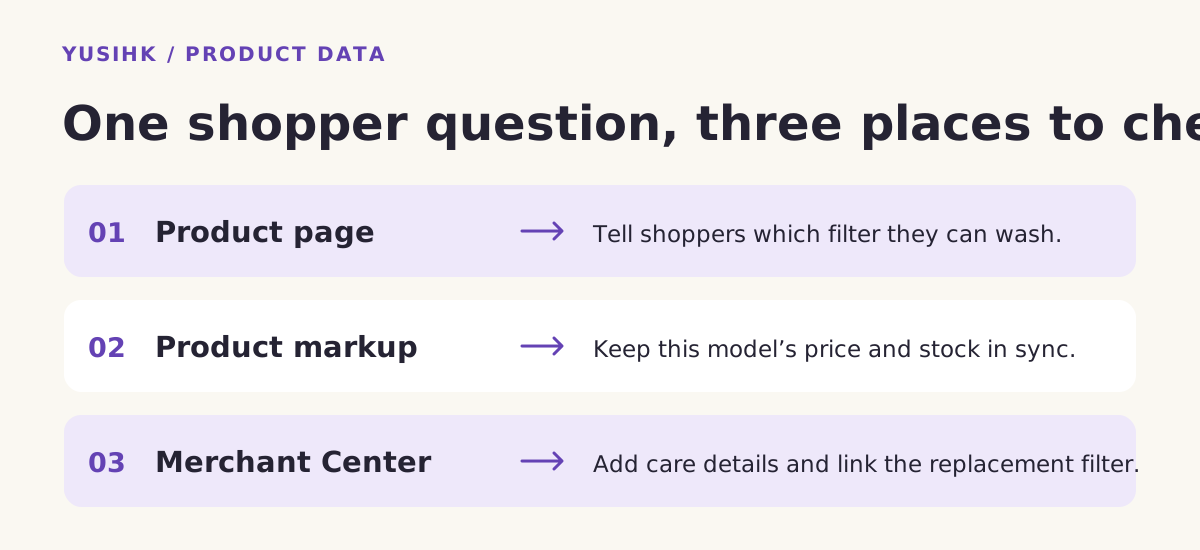
We downloaded and parsed Google’s TSV template. It contains an id header, all six conversational attributes and one sample record. These fields are optional and separate from the language and market rules for ads. To try one product, match a supplemental source to an existing product ID. If the supplemental tab is missing, check the Advanced data source management add-on in Settings or check whether your primary feed tool can export the fields. Google’s template and submission options · Supplemental data source setup
Which budget tool would actually help your store?
Start with what is holding the campaign back. Matching affects which searches can trigger an ad. Bidding affects how you compete for those searches. A total budget can suit a promotion with a fixed end date, while channel priorities address where the money goes. The preceding Ads Decoded episode covered those channel controls separately. 15 October episode
- Smart Bidding Exploration requires Target ROAS on an eligible Search, Shopping or Performance Max campaign. Exploration can pause when the campaign hits a budget constraint. It adjusts bids within eligible traffic. Matching changes such as AI Max can broaden that traffic. In Google’s example, a 200% target with 10% tolerance gives an effective average target of 180%. If testing both tools, Google recommends letting AI Max stabilize first and observing Exploration for at least six weeks. Exploration eligibility · Testing guidance
- Campaign total budgets: available when creating new campaigns, with no switch from an existing daily-budget campaign. Search, Shopping and PMax generally use 3–90-day periods. The charging cap covers the whole period, with no daily spending limit. Source
- Channel controls: rollout starts progressively on 15 October. Low-priority allocation is a best-effort share of average daily budget, not a guaranteed daily cap. Demand Gen supports prioritization but not this allocation control. Among campaigns using total budgets, prioritization is supported only for Demand Gen. PMax groups Google surfaces together here, so this does not isolate AI Mode. Source
If your budget is tight, change one spending setting at a time. Save the old setup so you can make sense of the result, and check that the setting is actually available in your account before building a plan around it.
Try one product in one market
If you already sell into Singapore, choose an in-stock product that ships there and gets regular questions. If you mainly sell into the UK, you can run the same store checks while waiting for confirmed ad availability.
- Follow the feed URL to checkout. In Merchant Center, check that the SKU is eligible for Shopping ads in the target market. Open the submitted variant URL, enter a local postcode, and check language, price, currency, stock, shipping and returns. Key product and checkout information should use the data source's language. If you do not use currency conversion, check that the feed, page and checkout use the required currency consistently. Fix discrepancies before spending. Landing-page requirements · Checkout requirements
- Answer recurring questions on the product page. Use support tickets, return reasons and visible search terms to pick three to five questions. Add useful evidence such as dimensions, compatibility, replacement parts or shipping details. Save the previous version and hold bidding and budget steady at first. If you observe an ad in the target market, record the prompt, follow-up, time, language and device. Each observation describes a single result.
- Set your acquisition cost limit, then test one campaign change. Subtract the profit you need to retain from the contribution per order after product, fulfilment, payment and expected return costs. If each order contributes US$30 and you want to retain US$10, your test ceiling is US$20 per acquisition. Set a spending limit and review window in advance. If cost still exceeds your ceiling after allowing for conversion lag, pause the expansion. These figures are illustrative.
- Judge the campaign change using the data you can see. AI ad performance is pooled in existing campaign and search terms reports, which omit some low-volume terms. Review spend, purchases, returns and contribution for the market to decide whether to keep the change. Pooled metrics cannot isolate AI Mode CPA or ROAS, and a before-and-after difference alone cannot identify a placement effect. AI ad reporting · Search terms reporting
Review organic search separately. Search Console's Web totals include AI search features. Its generative AI performance report covers organic impressions in AI Overviews and AI Mode and can group them by page and country. Search Central · Generative AI performance report
Keep product claims easy to verify
Google Ads policies still apply. Paid placements and organic AI responses operate independently. Some ads appear beside a Google-generated explainer that can draw on public website information and that advertisers cannot edit or approve. Spell out any limits on claims, compatibility, certification and warranty by market so that shoppers can verify what applies to them. Google Ads policies and explainers
When turning support questions into page copy, retain the product details and remove customer identifiers.
If the customer clicks but cannot take the next step, check your site against the AI search handoff guide.
For other AI product announcements, the merchant-readiness guide separates access, cost and transaction responsibility.
If you have time to edit one page tonight, pick the purifier people keep asking about. Put the sleep-mode measurement and its conditions where someone can find them. Your support team will have something useful to send the next person who asks. Let orders, returns and margin guide any increase in spend.
For monthly reporting, keep avoided charges separate from later credits. See Google Ads invalid traffic cost reconciliation.