
SEO Insights
What should Hong Kong product pages explain after a visual search?
Imagine a shopper holding a photo taken in a café and trying to find a similar coffee grinder. The shape is visible, but the model, plug, capacity and suitability for pour-over coffee may not be. A product page that says only “professional coffee at home” leaves the shopper with the same unanswered questions.
Google’s October 2026 coffee example shows AI Mode comparisons, questions about a photo through Lens, and live camera conversations. For a Hong Kong retailer, the practical opportunity is to connect those questions with verifiable product information. The recommendations below are YUSIHK’s website guidance, not a new Google ranking formula.
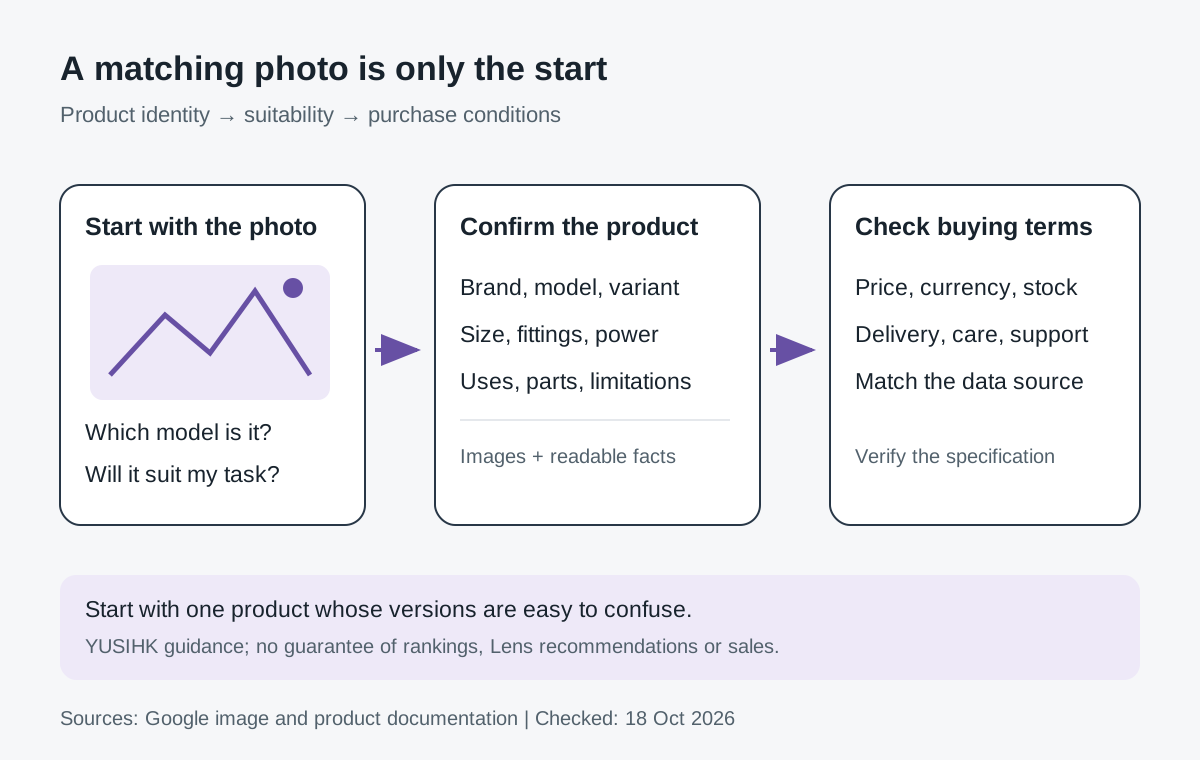
A photo can lead to three different buying decisions
“What is this?” calls for a brand, model and distinguishing details. “Will it work for me?” calls for dimensions, compatible equipment and limitations. “How can I buy it?” calls for a specific variant, price and fulfilment options. A single lifestyle image rarely answers all three.
Take the grinder as a hypothetical example. Useful details might include the exact model, burr type, capacity, electrical specification and supported brewing methods. Publish those as facts only when the manufacturer or supplier can support them. Do not assume every grinder suits every brewing method. Similar-looking furniture, lights and kitchen accessories can also have different dimensions, fittings or included parts.
Put visible features beside the facts a buyer must confirm
| Buyer’s question | What the image can show | What readable page text should add |
|---|---|---|
| Is this the same model? | Front, side, label and packaging details | Brand, full model, version and included accessories |
| Will it fit or connect? | A scale reference and close-ups of fittings | Units, dimensions, installation needs and incompatibilities |
| Is it suitable for the job? | Actual controls and use positions | Supported uses, care requirements and limitations |
| Which version am I buying? | Images for the selected colour or capacity | Selected variant, price, stock and delivery or collection terms |
Start with differences that can change the purchase decision. If two similar lights require different fittings, show that distinction near the option selector. Do not leave it in a document the buyer may never open. Keep the selected variant and displayed images aligned as well: choosing a white model should not leave the buyer looking only at the black version.
Images and text must also be accessible to readers and crawlers
Google’s image guidance explains that surrounding content and alternative text help it understand an image. Important specifications should therefore remain readable text on the page. Alternative text should describe what the image actually shows, rather than carrying a list of prices, stock claims and keywords.
Check that the product image is present in an image element with an accessible URL. Then check whether the model and options can be found easily on a phone. A useful caption can explain a detail that is hard to recognise from the photo alone. These basics support understanding; they do not establish that a particular image will appear for a particular visual query.
Product markup must agree with the actual offer
Google’s Product structured data documentation describes possible product appearances in Search, Images and Lens. Choose markup appropriate to the page and keep the model, price and availability consistent with what customers can see. There is no markup field that guarantees a Lens recommendation.
If the shop also uses Merchant Center, identify how product IDs and variants map between the store, product page and submitted data. A stock update in one system is not evidence that every Google surface has refreshed. Likewise, the coffee article’s nearby-stock example does not prove that a particular Hong Kong retailer has an eligible local inventory integration.
Confirm the feature conditions separately from the website work
As checked on 18 October 2026, Google’s AI Mode availability page lists Hong Kong. The Search Live help page describes its app and permission requirements. Specific shopping and personalisation features still need their own language, account and product checks.
The website improvements do not depend on every shopper having the same interface. An accurate model number, a clear limitation and reliable delivery information remain useful when someone arrives through ordinary Search or a shared link.
Walk through one easily confused product first
Choose a product whose versions are often difficult to distinguish. Give a person unfamiliar with it two photos, then ask them to find the matching version, decide whether it suits the intended task and explain the buying conditions. Record where they become uncertain and add the missing evidence. This is a suggested review method, not a claim that YUSIHK conducted a customer test for this article.
Afterwards, review the relevant page’s search performance, variant interactions and repeated specification questions. GSC impressions or one AI response cannot identify an individual Lens visit, and neither proves a qualified enquiry or sale.
If the problem spans product variants, image context and technical output, start with the scope of our English SEO services. Bring one product URL, the relevant photos and a current specification source. That gives the review a concrete place to begin.
Sources checked: 18 October 2026.