
SEO Insights
Google’s September AI updates: what cross-border merchants should verify before adopting them
A Hong Kong team selling overseas sees that Google’s new voice models can complete complex tasks. Should it rewrite every product page as a Q&A, subscribe to another tool, or connect its store? The first useful question is more concrete: which product can the customer actually access, and what evidence will support the answer it gives?
Choose a use case by its access conditions and transaction responsibilities, then verify it against product evidence. A stronger model does not guarantee a citation, and an app connection does not establish a new sales channel.
This article cross-checks public official documents. It does not report a signed-in merchant trial, a paid API invocation, generated product assets or a completed order. The scenarios and test procedures below are proposals, not performance results.
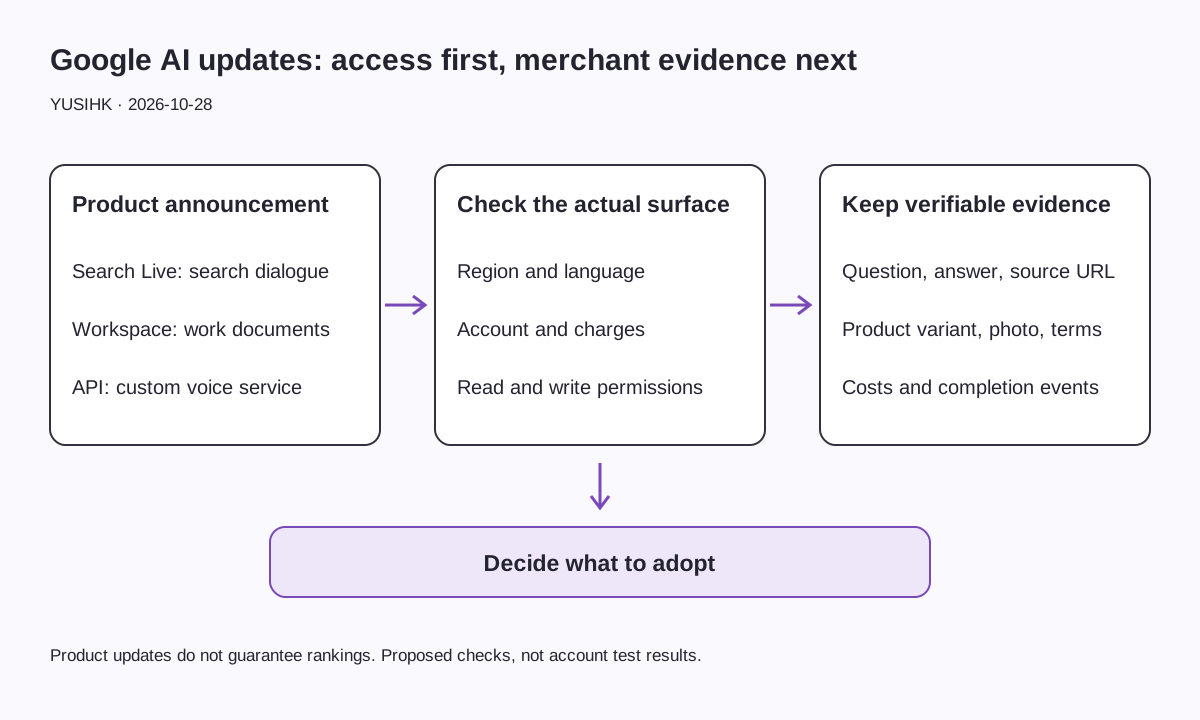
A monthly recap is not a current access specification
Google’s September roundup covers Argon, Flash, voice, creative and scientific products. It is not a search ranking update or a new advertising policy.
Read the individual launches before joining those capabilities together. The Live model announcement distinguishes Search Live assistance from Workspace document tasks and Gemini app workflows. It does not establish that Search Live inherits permission to operate a user’s Gmail, Docs and Keep. The TTS launch is about generating speech, not an installed store assistant with authority to place orders.
Dates matter too. The recap describes Argon’s restricted initial release. Google subsequently opened paid developer access on 13 October. Its later release description also discusses a unified input-output allowance. Do not interchange an input context window, an output ceiling and a workflow allowance when estimating a document-processing job.
Customer availability and developer availability are different checks
Search Live help identifies the Google app on Android and iOS and refers to AI Mode’s supported regions and languages. The AI Mode list includes Hong Kong, English, Traditional Chinese and Japanese when checked.
The AI Studio and Gemini API region list includes Japan and the United States but does not list Hong Kong. A Hong Kong operator cannot use customer-facing Search availability as proof of API eligibility. Check the operating entity, supported location and account terms before committing to an implementation.
Documented language support also does not prove recognition of your product names, mixed-language speech or addresses. Record the tester’s location separately from the shopper’s destination market. Test the actual product vocabulary rather than relying on a generic multilingual demonstration.
Budget for a workflow, not a model label
Google’s Workspace voice announcement specifies different subscription and rollout conditions. Those subscriptions should not be treated as a bundle of developer API credits.
At the checked Live API Standard audio rates, one minute of input plus one minute of output is approximately $0.023 for those audio components. That is an illustrative calculation, not a total cost per session: text, reasoning, search grounding, retries, storage and infrastructure can add costs. The pricing page also distinguishes free- and paid-tier product-improvement data use; review the broader retention and logging terms separately. Use fictional orders and public product data for an initial prototype.
Make product answers preserve the shopper’s conditions
Imagine a shopper asking whether a travel charger works in Japan, then adding that it must power a laptop and arrive before departure. This is a hypothetical example. An adequate page needs plug specifications, voltage, power delivery, compatibility and destination-specific delivery conditions. “Works worldwide” does not resolve those questions.
Improve the existing product page with supported and unsupported cases and links to specifications and delivery terms. Do not create a near-duplicate URL for every follow-up. Google’s website guidance for AI search does not require special AI schema. This is a content usability recommendation, not a Search Live inclusion formula. The next step must also reach the right variant and language; see website handoffs from AI search.
A useful AI-versus-photo comparison starts with the same SKU
A polished generated charger with three ports misrepresents a two-port product. To evaluate assets, keep the SKU and physical version fixed. Save original multi-angle photos, measured dimensions and the packing list. Record the generation prompt, model and revisions separately.
Compare port counts, labels, accessories and dimensional presentation using the same questions. Log factual errors and human correction time. These are proposed checks; no such asset experiment was performed for this article.
Only after accuracy checks should a team consider a controlled advertising comparison with a defined audience, budget, landing page and observation period. An attractive image is not evidence of a conversion lift. For Merchant Center submissions, Google requires AI-image provenance metadata to be retained. Check the delivered file after export and CDN processing; an on-page disclosure does not replace file metadata.
App connections do not establish checkout or advertising eligibility
The September recap does not justify a bid or budget change. Google’s 20 October small-business announcement names Shopify, Wix and Google Ads and describes a gradual rollout. Verify each connector’s actual read and write operations before inferring inventory access, campaign changes or checkout. Merchant transaction responsibility remains a separate issue; the UCP transaction-data guide explains that distinction.
Other recap items may improve production work without changing search eligibility. Weather forecasts are not your delivery promise; generated music is not product photography. Evaluate the business need before adding another tool or a new content section.
Start with one frequently questioned product and one repeatable conversation. Record date, location, language, interface, any displayed model, follow-ups, source links and final destination. If no model is displayed, record that limitation. Separate answer accuracy, a source link, a website visit and a completed action. This article contains no site Search Console analysis or measured Search Live growth.
If the answer is wrong, fix the product evidence. If the answer is right but the handoff fails, fix the destination. Expand automation only after access, responsibility, costs and error handling are clear.