
SEO Insights
Google’s October AI update: what to check in your store’s product images
“Can that port charge my laptop?”
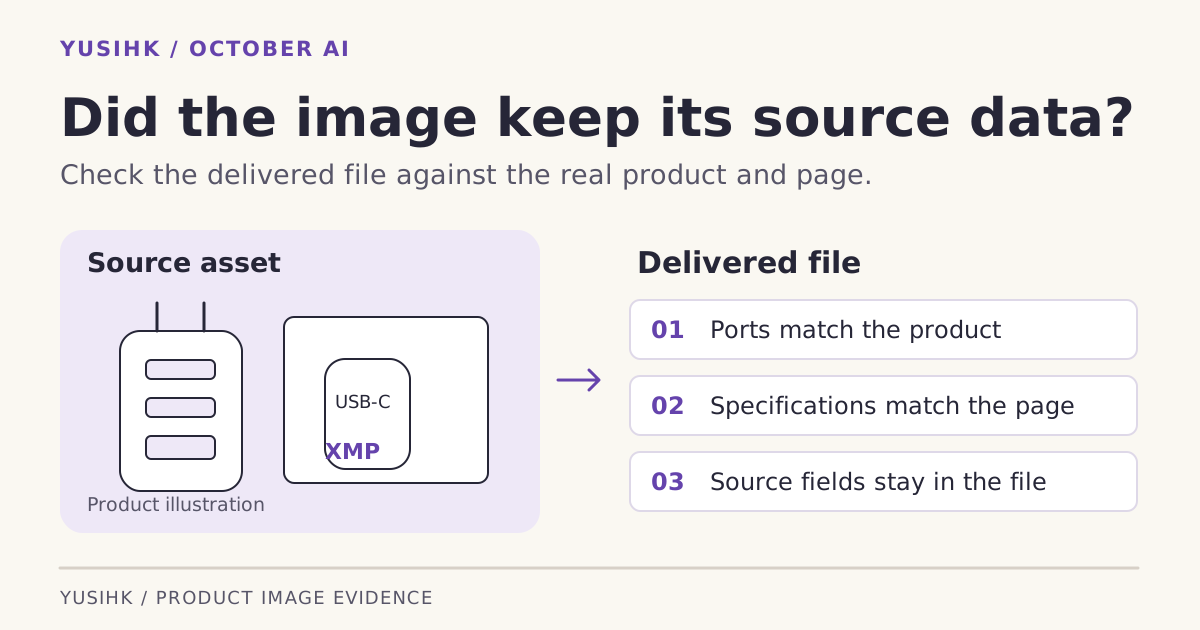
If you sell travel chargers, the answer needs to come from the right model’s port photo, power specification and test conditions. After changing the background, resizing the picture and sending it through your CDN, download the file a shopper actually sees. Count the ports, read the power label and check whether its source metadata survived.
Google published its October AI recap on 2 November 2026. This guide follows two practical questions for stores: what SynthID Detector can establish about a picture, and which Gemini 4 product a customer or merchant can actually access. Public sources and the conversion test were rechecked on 11 November.Google’s October recap
What a SynthID check can establish
The English detector opened globally on 7 October for images, video and audio. Google’s 29 October update lists Apple alongside OpenAI, NVIDIA and Kakao as supported partners. Coverage depends on whether the media carries a signal the tool can detect. A file with no detected watermark still needs provenance evidence. A positive result tells you something about how it was made, while accuracy about the product requires its own verification. Google reports over 180 billion watermarked images and videos and about 240,000 years of audio. The more than one million daily requests refer to built-in verification in Search, Chrome and the Gemini app. Google’s dated SynthID announcement · How SynthID works
On 10 November, the public detector returned HTTP 200 and the page title loaded in our check. The test browser displayed no upload interface, so this article has no detector result for any file. Account, price, upload size and duration limits were not confirmed. SynthID Detector
There are two separate things to inspect. SynthID embeds an imperceptible watermark in the media. IPTC source information can be recorded in the file’s XMP metadata. The conversion test below reads and writes XMP. A picture can still display correctly after those fields disappear, so inspect the delivered file after the last conversion. How SynthID works · Merchant Center source metadata rules
A file conversion check you can repeat
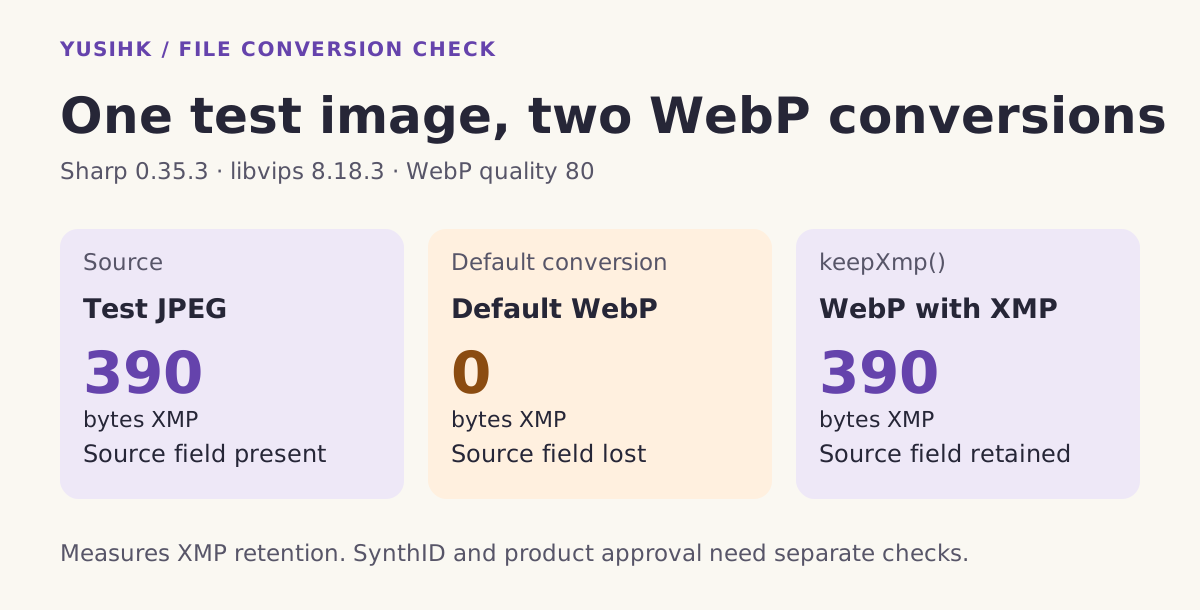
We drew a geometric test image and inserted the IPTC DigitalSourceType=trainedAlgorithmicMedia value into JPEG XMP. Using Sharp 0.35.3 and libvips 8.18.3, we converted it from 1,200 × 800 to 600 × 400 WebP at quality 80. The original had 390 bytes of XMP. The default WebP had zero. With keepXmp(), the WebP retained all 390 bytes and the field value. This measures metadata retention for one configuration. SynthID survival and Merchant Center approval were outside the test. Merchant Center image specification
Check the actual file served by your feed or CDN. Keep traceable product shots or reliable manufacturer images for the SKU, and use your own photographs and measurements when making hands-on review claims. Compare generated lifestyle scenes with the real product before publishing. A visual note can explain a composite to the shopper, while generative AI images sent to Merchant Center must also retain the applicable source metadata. Review the structured feed fields when AI generates titles or descriptions. Merchant Center AI-generated content requirements · Product-page evidence for visual search
For advertising, test one approved image change at a time. Record the original and final asset, landing page and SKU. Keep pricing, audience and delivery conditions comparable where practical. Track fulfilled orders, cancellations, returns and margin alongside click-through rate.
Before paying for Argon, check the product you are opening
The 13 October launch listed Argon in AI Studio, the API and Google Cloud, and for Google AI Pro or Ultra subscribers in the Gemini app and AI Mode. On 11 November, however, the model section of Search Help described Gemini 4 Carbon. We therefore no longer present the draft’s earlier Argon country and age details as a current availability list. Check your own model selector and local plan benefits before paying. A Search launch announcement does not identify the model behind every ordinary AI Overview. Argon launch · Current Search Help · Consumer plans
The Gemini Developer API Standard tier is billed separately and has no free Argon tier. Per million tokens, US$2 input and US$10 output apply through 30 November, changing to US$4 and US$20 from 1 December. Output includes thinking tokens. Japan and the US are listed for AI Studio and the Developer API, while Hong Kong is absent from that list. Consumer plan prices and Cloud billing use separate terms. The figures were checked against documentation without buying a subscription or making paid API calls. Developer API pricing · Supported regions · Consumer plans
When AI impressions and clicks move in different directions
Search Console’s dedicated generative AI report shows AI Mode and AI Overview impressions by page, country, device and date. It may be unavailable when impressions are too low. Clicks to external pages are counted in overall Search performance under Google’s rules. These views cannot isolate Argon clicks. Compare equivalent periods and page groups, record demand and SERP changes, and check useful visits and orders. For a guide that already has visibility, add something a shopper needs to verify on the page, such as a measured fit, a photo of a port or a compatibility table with conditions. Generative AI report · Search Console counting rules · Website handoff after an AI answer
Google also reports over five million suspected scam calls and messages flagged each month. Enhanced protection in Google Messages is optional and rolling out, with cloud analysis through Private AI Compute and separate call-forwarding and screen-sharing safeguards. Make official support and payment links easy for customers to verify. EmbeddingGemma 2 is a 740-million-parameter model for local multimodal retrieval. The maximum sixfold vector storage reduction refers to 768 versus 128 dimensions. Gemini Notebook’s interactive learning, quizzes and pre-generation controls for slides and video can support internal training. The recap also records Carbon, Genie 4, Fitbit Edge, AMIE, Suncatcher and quantum research. Android safeguards · EmbeddingGemma 2 · Notebook co-creation
If you have time for one check today, download the live image for a charger you sell often. Count its ports against the real product, inspect its source fields, then put missing power or compatibility details on the page. Your support team can send that page to the next shopper who asks. Use the preceding guide to compare access and costs across Google products.September merchant readiness guide