
SEO Insights
How to Choose a Hong Kong SEO Agency: A Buyer’s Checklist
Comparing SEO proposals is difficult when every supplier uses a different mix of audits, keywords, content, technical work and reporting. A useful buying process does not begin with a promised position or a fixed article count. It begins with the business outcome, the website pages that matter, who can make changes and how both sides will verify the work.
This checklist is for English-speaking management, marketing and regional teams buying SEO support for a Hong Kong website. It is not a ranking of agencies. It provides a common set of questions for comparing an agency, a specialist consultant, an internal-plus-external arrangement or SEO support attached to a website rebuild.
Start with the commercial problem, not the SEO package
Write down one outcome that the website should support during the first review period: qualified enquiries for a priority service, bookings in a defined location, sales for a product category or a safer migration to a new website. Then identify the pages and enquiry routes connected to that result.
This prevents a proposal from treating every problem as a content-production problem. A local service business may need Google Business Profile consistency and location pages. A B2B company may need clearer service scope and evidence. An ecommerce business may need category, product, delivery and structured-data work. A site redesign may need URL mapping, redirects and launch controls before new content.
Ask every supplier to work from the same priority URL list
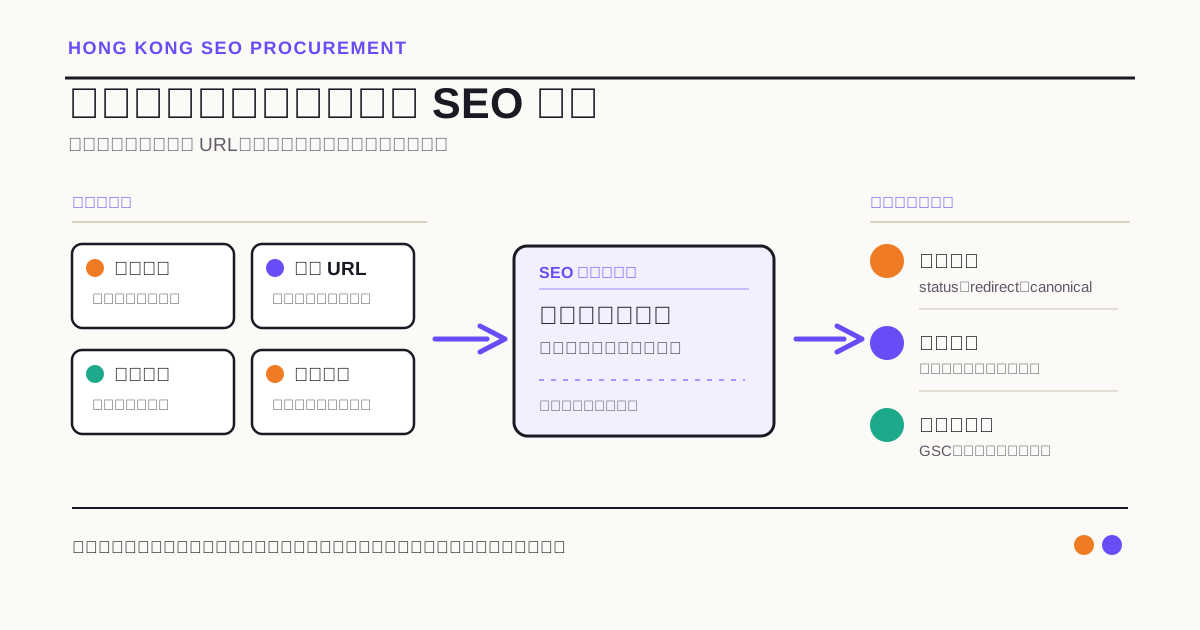
Prepare a first list of roughly 10 to 20 URLs: the homepage, core service or category pages, contact pages, important articles and any historical URL with traffic or links. For each URL, record its commercial role, known search queries, current status and internal owner. The exact list can change after diagnosis, but it gives every proposal the same starting point.
| What to request | Why it matters | How it can be accepted |
|---|---|---|
| Priority URL and search intent | Prevents one keyword from producing several competing pages | Each important intent has one accountable page or a documented reason for a new URL |
| Proposed change and owner | Shows whether the work is strategy, copy, development or approval | The ticket identifies the affected page, implementation owner and review method |
| Technical baseline | Separates crawl, index, canonical and rendering problems from content issues | Status, canonical, robots, sitemap and internal discovery agree on the preferred URL |
| Measurement baseline | Stops rankings from becoming the only result | Search Console query and page data are recorded alongside the available enquiry signal |
Nine questions to use in the first agency interview
- Which pages would you review first, and why? A specific answer should name sample URLs, evidence and risk—not only keyword research.
- How will service pages, guides and technical work divide the search intent? Ask how the supplier avoids near-duplicate pages and keyword cannibalisation.
- Who implements each recommendation? Clarify what the agency changes directly, what goes to developers and what requires brand or legal approval.
- What access is needed? Search Console, analytics, CMS, hosting, DNS and Google Business Profile access should be requested only for an agreed task and at an appropriate permission level.
- Who owns the accounts and assets? The client should retain organisational ownership of its domain, website, core Google properties, content files and reporting history.
- How are changes documented and checked? A useful record identifies the URL, previous state, reason, release date, validation result and rollback or follow-up condition.
- How will success be measured? Ask for search visibility, landing-page and index evidence to be connected to qualified enquiries, sales or another business result where data is available.
- Which outcomes are outside the supplier’s control? No provider controls Google crawling, indexing, ranking systems, competitor activity or AI citations. Fixed guarantees should be treated cautiously.
- What happens when the engagement ends? Agree the handover of accounts, content, URL maps, technical tickets, dashboards, source files and outstanding decisions before signing.
Separate deliverables from activity labels
Terms such as “technical SEO”, “content optimisation” and “monthly reporting” are too broad to accept on their own. Convert each label into an output. A technical review might produce a prioritised URL-level issue list with implementation and validation notes. A content engagement might define which existing pages will be updated, what evidence the client must supply and who approves commercial claims. Reporting should state what changed, what Google has processed, what remains uncertain and what decision follows.
Google’s own guidance recommends interviewing a potential SEO about expected results, timing, measurement, industry and geographic experience. Google also warns that advertising does not affect organic presence and that irresponsible practices can damage a site. The point is not to ask an agency to repeat Google documentation; it is to see whether its recommendations can be traced to the live site, first-party data and current official guidance.
Keep Search Console and account control with the business
Use a company-controlled account as the long-term owner of the domain, Search Console, analytics and other core properties. External specialists can receive the access required for their work, with named users and a review date. Avoid arrangements where a supplier’s personal account is the only owner or where changing suppliers would remove the company’s access to its own data.
Search Console does not report every business result, and its query tables may not contain every row. It is still the first-party source for Google Search queries, landing pages, clicks, impressions, average position and index evidence. Agency dashboards and third-party estimates can organise or extend the analysis, but should not be presented as Google’s internal ranking data.
Define a first 30-day acceptance gate
A sensible first month does not need to promise traffic growth. It should create a reliable operating baseline. The buyer should be able to identify the priority URLs, current technical state, relevant queries, proposed changes, responsible people and the first observation window.
- The priority page list and commercial roles are agreed.
- Required access is granted through company-controlled accounts.
- High-risk technical issues and migration dependencies are separated from content opportunities.
- Every recommendation names an affected URL, owner, evidence and acceptance method.
- Commercial claims and examples remain subject to human editorial approval.
- The next review uses the same Search Console and enquiry definitions as the baseline.
Red flags that deserve a second question
- A guaranteed first position, guaranteed traffic or guaranteed inclusion in an AI answer.
- A proposal built only around keyword count, article count or link volume, without priority URLs.
- Requests for full account control before the task and permission level are explained.
- Reports that show movement but do not identify what changed on the website.
- Advice described as “approved by Google” because it came from a third-party tool or service.
- No written handover, ownership or exit arrangement.
A practical next step
If you are still defining the search scope, start with Google SEO services for Hong Kong businesses and YUSIHK SEO services. If your decision also involves AI answer surfaces, compare the separate responsibilities in Hong Kong GEO services. To discuss a website, target market and priority service before requesting a full proposal, contact YUSIHK for an initial review.